
Running a Check in Louisiana
The Louisiana State Police registry gateway is the official starting point. Louisiana State Police BCII maintains the central list under state law, while sheriffs and certain police agencies register people, verify information, and send updates into the system. The public list concerns people whose offenses and legal status require publication. It is not a general arrest search, and a listing should never be read as proof of a new offense.
Start with the Louisiana statewide result, confirm the photo and physical details, and note the agency responsible for the profile. If a Louisiana residence, work, school, or compliance entry seems wrong, use the Louisiana parish directory to reach the local custodian. For a Louisiana judgment, plea, sentence, or later court action, request the source case from the parish clerk. That layered check separates current Louisiana registration data from the older conviction record.
The official registry page also sets the conditions for public use. Its layout is visible in the Louisiana State Police registry source.
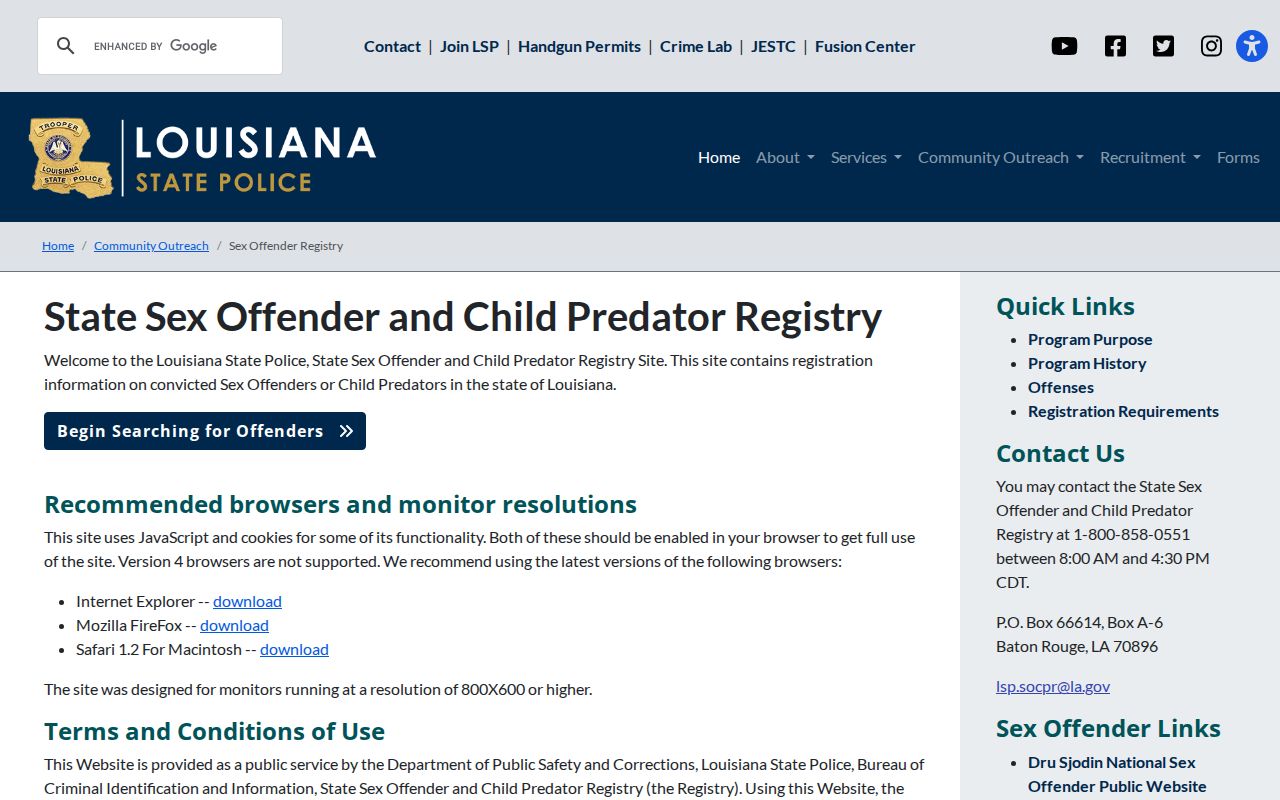
The gateway points searchers to Louisiana OffenderWatch and reminds them to verify information with the Louisiana agency that manages the listing.
Parishes Feed Louisiana OffenderWatch
Louisiana registration is a state and parish partnership. Before release, Louisiana corrections officials collect preregistration information. Afterward, a person generally reports in person to the Louisiana sheriff for each parish tied to residence, work, or school. Police duties can also apply in incorporated areas, and campus police receive required information before postsecondary attendance. The local office updates Louisiana OffenderWatch, while LSP validates the central Louisiana record and sends eligible data to national systems.
Louisiana moves create more than one duty. A person moving between Louisiana parishes appears with the new sheriff and gives separate notice to the former agency. Many Louisiana changes must be reported in person within three business days. Temporary lodging for seven straight days also triggers advance notice. These local steps explain why a Louisiana profile can show several home, work, school, volunteer, or other-address modules. They also explain why the responsible Louisiana parish is the best place to question a recent location change.
Registration flow: Corrections preregistration › Parish registration and verification › OffenderWatch update › LSP central registry › National sharing
Note: A Louisiana parish managing agency can confirm a recent move before the central public profile reflects the change.
Searching the Louisiana State Sex Offender and Child Predator Registry
The official Louisiana OffenderWatch search is free and does not require an account after its conditions are accepted. It separates address, name, city, non-compliant, and exact internet-identifier searches. Each mode answers a different question. A partial name also checks aliases, while an exact email or phone query can report that the value is connected to a registrant without revealing the person.
- Accept the official conditions and choose the search block that fits the question.
- Use a partial name for spelling variants, or enter a complete address, city, state, and ZIP for an area search.
- Open a possible match and compare the photograph, age, physical description, addresses, offense, and managing agency.
- Verify unclear data locally, then use an address alert or profile tracking if ongoing notice is useful.
| Field Label | Type | Required | Notes |
|---|---|---|---|
| Address, City, State, ZIP | Text and dropdown | Yes for area search | Finds published home, work, volunteer, or school locations near a point. |
| ZIP Plus | Text | No | Adds the optional ZIP+4 suffix. |
| Last and First Name | Text | No marker | Partial matches are accepted and aliases are checked. |
| City | Text | No marker | Accepts a partial city match. |
| Non-Compliant | Link | No | Shows a changing status subset, not the statewide total. |
| Email or Phone | Exact text | No marker | Confirms a link without identifying the registrant. |
| Map and Address Results | Map or list | Address needed | The live accessible view did not expose radius values. |
| Email Alerts | Signup | No | Sends notice when a published registrant enters the selected area. |
Louisiana registry results and the Louisiana profile format can be seen through the LSP public registry interface.
Louisiana results must still be checked against profile details because similar names, aliases, stale locations, and non-mappable addresses can complicate a match.
Louisiana Registry Status Terms
Several Louisiana labels are easy to overread. “Non-compliant” refers to a reported failure involving Louisiana registry duties. It does not by itself prove a new conviction, and an active-warrant flag is a separate field. “Non-mappable” means a Louisiana address could not be placed on the map. It does not always mean the person’s location is unknown. A negative Louisiana result can reflect a spelling problem, delayed data, an out-of-state move, or a status that state law does not publish.
- Published
- The profile meets Louisiana’s rules for public display.
- Non-compliant
- The managing agency has reported a registration-duty problem.
- Non-mappable
- The address cannot be plotted reliably, though text details may remain.
- Active warrant
- A separate flag that calls for verification through law enforcement or the issuing court.
Search across state lines through the U.S. Department of Justice national registry search, then return to the Louisiana or other jurisdictional source for verification.
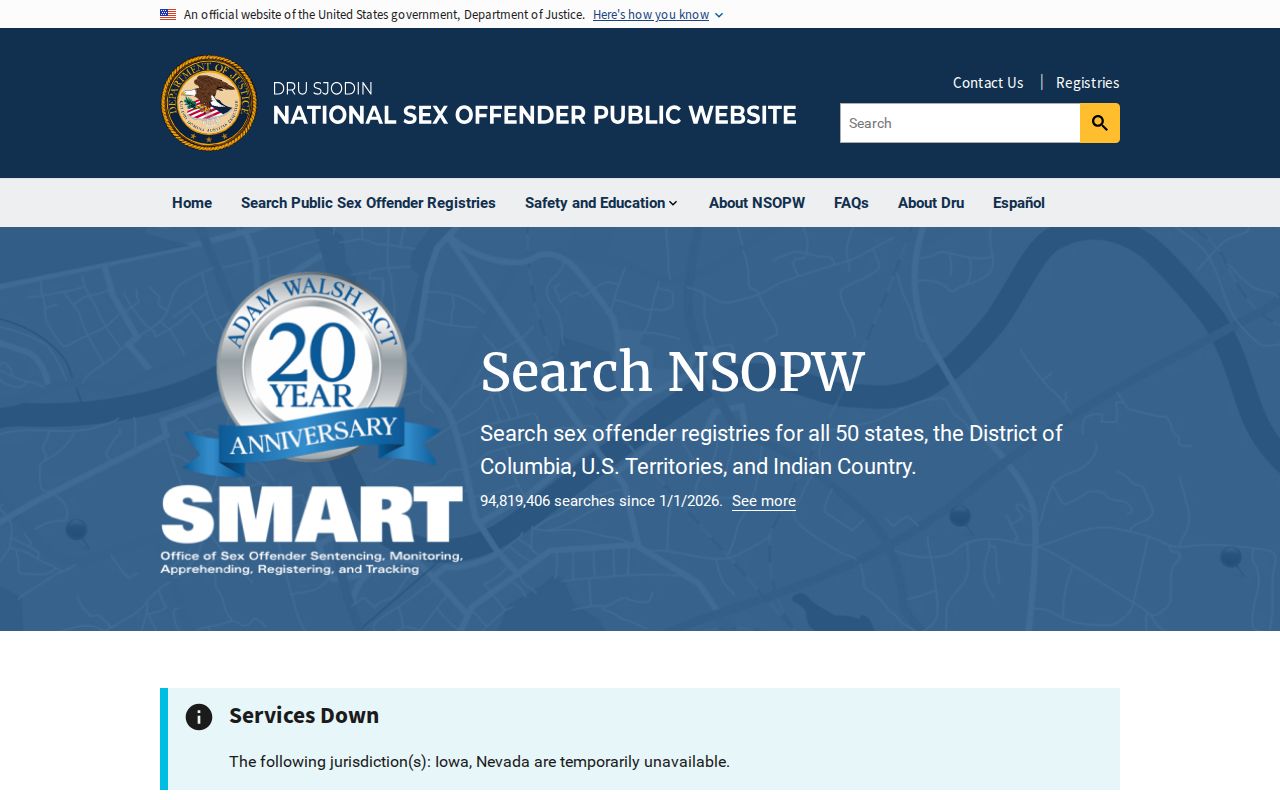
The national search widens geographic coverage, but the managing Louisiana agency remains the source for current Louisiana status.
What a Profile Shows
A Louisiana profile is a public safety notice rather than a complete Louisiana criminal case. It can identify the registrant, show published Louisiana locations, name the registration tier, and describe the qualifying offense. Separate Louisiana modules may show work, school, volunteer, vehicle, other-address, warrant, or compliance information. Empty modules can mean “none reported” or that a field is not public. They do not prove the Louisiana agency never collected the information.
| Name and identity | Name, registration number, age, full date of birth, photograph, sex, race, height, weight, hair, eyes, scars, and tattoos. |
|---|---|
| Published locations | Street address and home, work, school, volunteer, other-address, city, ZIP, and mapping modules when available. |
| Offense record | Offense description, statute link, conviction date, jurisdiction, and sometimes release details. |
| Tier and status | Tier I, II, or III, current status, last verification date, and possible non-compliance or warrant flags. |
| Vehicles and conditions | Plate, make, model, year, color, comments, and probation conditions when published. |
| Public actions | Tip or correction submission, profile tracking, print, and sharing controls. |
Louisiana keeps Social Security numbers, victim identities, non-conviction arrest data, phone numbers, email and online identities, and travel documents off the named public profile. Exact phone or email search follows a narrow confirmation rule and does not reveal the linked person.
Note: A blank Louisiana profile field may reflect public-display limits, not the absence of data in law-enforcement files.
Louisiana Registry Alerts Differ
Louisiana OffenderWatch offers two forms of follow-up. An address-proximity alert sends email when a published Louisiana registrant begins residence, work, or school within the chosen area. The Louisiana signup calls for a street address rather than a post office box, city, state, ZIP, email confirmation, and acceptance of its notice terms. A profile’s tracking control follows changes tied to one Louisiana listing instead. These tools monitor Louisiana registry events, not court dates.
Louisiana VINE is different again. It follows participating Louisiana custody and release events. A person can leave Louisiana custody yet remain registered, or change a Louisiana registry address without any new custody event. Choose Louisiana OffenderWatch for published registration-location notice and Louisiana VINE for custody notice. Neither replaces confirmation by the managing Louisiana parish agency.
Louisiana community notification is also distinct. Louisiana community-notice law can require mailed and published notice within one mile in rural areas or three-tenths of a mile in urban or suburban areas. Those Louisiana distances are legal notice rules, not a promise that the portal’s map radius uses the same measurement.
Registration Requirements and Levels
Louisiana tiers follow offense categories defined by Louisiana law. They are not personal clinical risk scores. Base duration and in-person verification frequency rise by category, but later Louisiana custody, repeated registerable offenses, juvenile provisions, compliance, residence outside Louisiana, and a Louisiana court-approved reduction can change the practical end date. A conviction date alone is not enough to calculate when Louisiana registration ends.
| Level / Tier | Duration | Verification Frequency |
|---|---|---|
| Tier I | 15 years | Annually |
| Tier II | 25 years | Every six months |
| Tier III | Life | Every three months |
| Repeat registrant | Life | Every three months |
| Enumerated juvenile adjudication | Life, with possible statutory reduction | Based on category |
| No fixed residence | Underlying term remains | Every 14 days in each regularly inhabited parish |
The official Louisiana tier and offense page connects the public categories with their statutory rules.
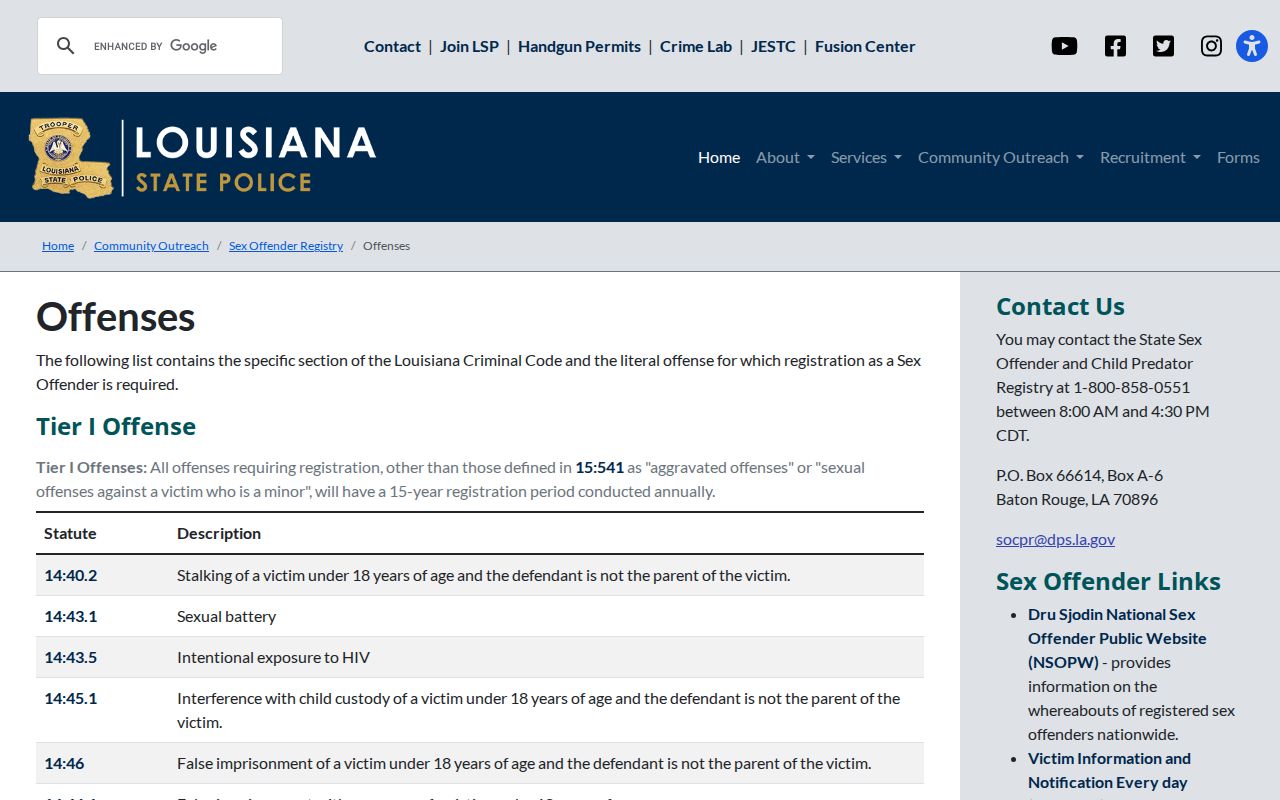
The official tier source helps distinguish the offense-based category from an individualized prediction about present behavior.
Louisiana generally uses the longer applicable term for comparable out-of-state, military, federal, tribal, or foreign cases. A limited reduction requires a court motion and proof under the statute. The Attorney General’s Sexual Predator Apprehension Team determines an expected end date after receiving compliance history from law enforcement.
Louisiana Registry Accuracy Checks
The Louisiana Legislative Auditor reported 11,312 actively registered people on February 13, 2020. That figure is historical, not a present total. Its audit found that all required people in the reviewed sample appeared in the registry, yet it also documented tier-support, work-address, deceased-record, and update-documentation problems. The findings support careful verification without authorizing a public user to reclassify a listing.
If an address looks wrong, submit the profile’s tip or correction, contact the managing sheriff or police agency, and use the State Registry contact for a central-data question. Call 911 only for immediate danger. A court clerk controls the conviction judgment and sentence, while the registry office controls present publication and compliance fields.
Note: Historical audit totals and a live non-compliant subset use different dates and definitions, so they should not be divided into a rate.
Lawful Use
The Louisiana registry exists for public safety and community awareness. It does not authorize threats, intimidation, harassment, discrimination, or vigilantism against a registrant or family member. LSP warns that misuse can create criminal or civil liability. Louisiana does not publish one universal special “registry misuse penalty,” so the consequence depends on the conduct and may involve general stalking, cyberstalking, or unlawful-communications law.
Location rules also demand care. Louisiana’s 1,000-foot restrictions apply to defined offense and victim categories, covered places, and statutory exceptions. They are not identical for every profile. A map marker is not a legal property-line measurement. Questions about a specific restriction belong with the managing agency, court record, and controlling statute.
Louisiana Registry or Court File
Use the Louisiana registry for present publication status, tier, verification date, listed addresses, managing agency, and alert tools. Use the parish district court file for the charging instrument, plea, judgment, sentence, and later case action. A listing may remain active long after custody or supervision ends, and a profile update can occur without a new criminal case.
This division prevents a common mistake. The public profile summarizes facts needed for statutory notice; it is not the full court record. When the exact conviction language matters, compare the profile’s statute and date with a certified judgment from the clerk. When current location or compliance matters, contact the sheriff or police agency named on the listing.
Note: Louisiana registry data and parish court records answer different questions, so a careful check may require both official channels.