
Criminal Cases in the Louisiana Courts
Louisiana divides criminal jurisdiction among several court levels. Judicial District Courts have general original jurisdiction and hear felony prosecutions within their parishes. Parish, city, municipal, traffic, and mayor's courts have narrower authority that depends on the law creating each court. They may hear misdemeanors, ordinance matters, traffic cases, and early proceedings. Five Louisiana Courts of Appeal review eligible district-court rulings. The Louisiana Supreme Court is the state's court of last resort.
The clerk for each court keeps its own Louisiana criminal case file. That fact matters. A district clerk's portal may not show a city-court misdemeanor or municipal bench warrant. An appellate opinion may be online while the exhibits remain in the trial file. The Louisiana Judiciary gateway is the best starting point for court structure and official clerk routes.
The Judiciary's public gateway shows how Louisiana court records are organized in this captured reference.
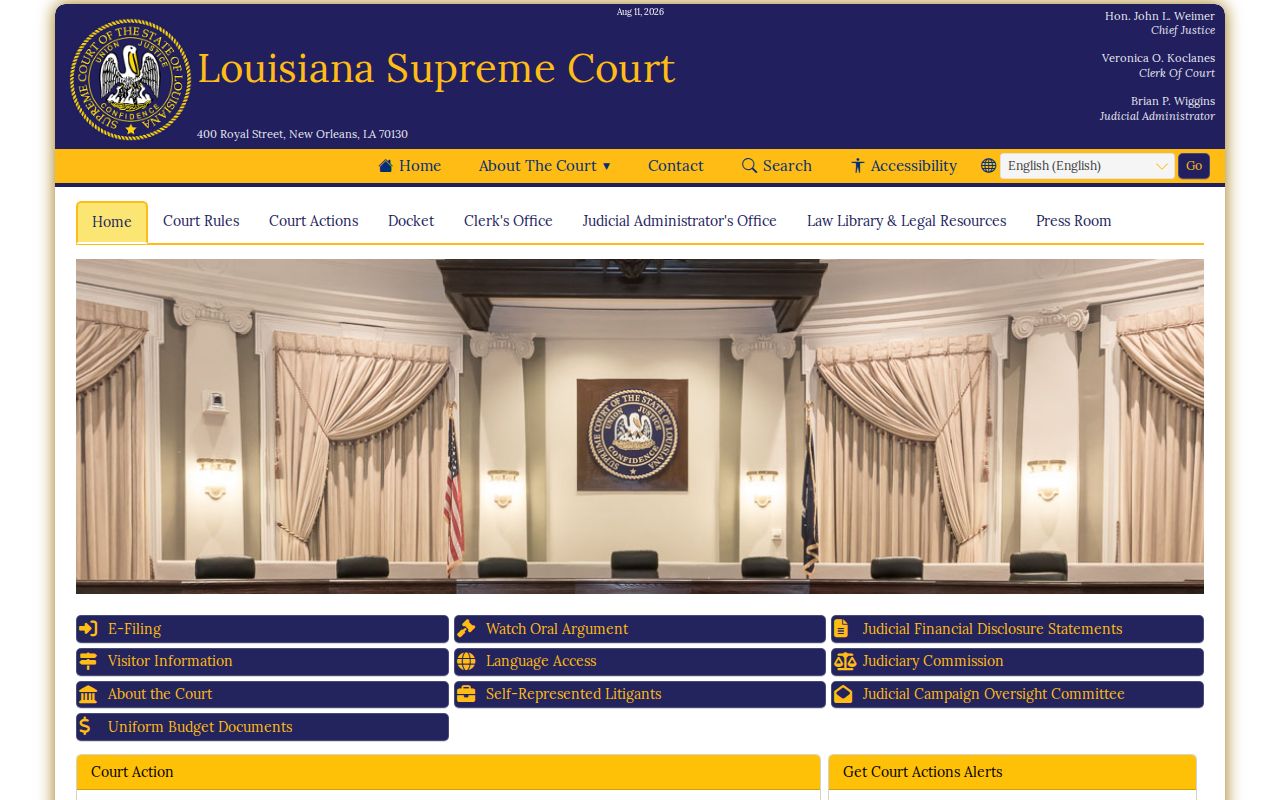
That statewide Louisiana directory identifies the right Louisiana court, but the selected clerk remains the record custodian.
Louisiana Criminal Courts by Level
Louisiana reports 43 district courts and 42 judicial districts because Orleans has separate civil and criminal district structures. The state also reports five courts of appeal, five family or juvenile courts, 48 city courts, and three parish courts. These counts describe the court system. They do not mean one portal contains every Louisiana criminal docket.
| Court layer | Typical criminal role | Record source |
|---|---|---|
| Louisiana Judicial District Court | Louisiana felonies and other matters within general jurisdiction | Louisiana parish clerk of court |
| Louisiana city, municipal, parish, or mayor's court | Authorized misdemeanor, ordinance, traffic, and preliminary matters | That Louisiana court's clerk |
| Louisiana Court of Appeal | Appeals and supervisory matters from district court | Applicable Louisiana appellate circuit |
| Louisiana Supreme Court | Direct or supervisory review as law permits | Supreme Court docket and clerk |
A Louisiana charge label alone does not always identify the court. Start with the Louisiana parish of prosecution and the charging instrument. A bill of information comes from the district attorney. An indictment comes from a grand jury. Both accuse; neither proves guilt. The court caption and docket number then point to the custodian.
How to Search eClerks LA Criminal Search
eClerks LA Criminal Search is account-gated. It collects Louisiana criminal minute and index information transmitted under the statewide Louisiana clerks' framework. It is not a free, complete archive of every pleading, image, historical case, city-court matter, or bench warrant. Public inspection confirmed only the login and registration controls. Post-login search fields, prices, result columns, and parish coverage cannot be stated as uniform.
- Register or sign in, then confirm that the selected parish offers criminal records through the service.
- Use a docket number when known. Otherwise search the available name and date controls shown after access.
- Read minute events by count. Check filing, amendment, dismissal, hearing, guilt, and sentence entries.
- Check a separate city or municipal court when the district result does not fit the case type.
- Request pleadings, images, judgments, or a certified disposition from the actual parish clerk.
| Public field | Type | Required | What it does |
|---|---|---|---|
| Text | Yes to sign in | Account identifier | |
| Password | Password | Yes to sign in | Protected credential |
| Remember me | Checkbox | No | Retains login state |
| Register | Link | No | Starts account creation |
| Forgot Password | Link | No | Starts credential recovery |
The official eClerks LA interface illustrates the Louisiana account gate and should be checked before assuming Louisiana online access.
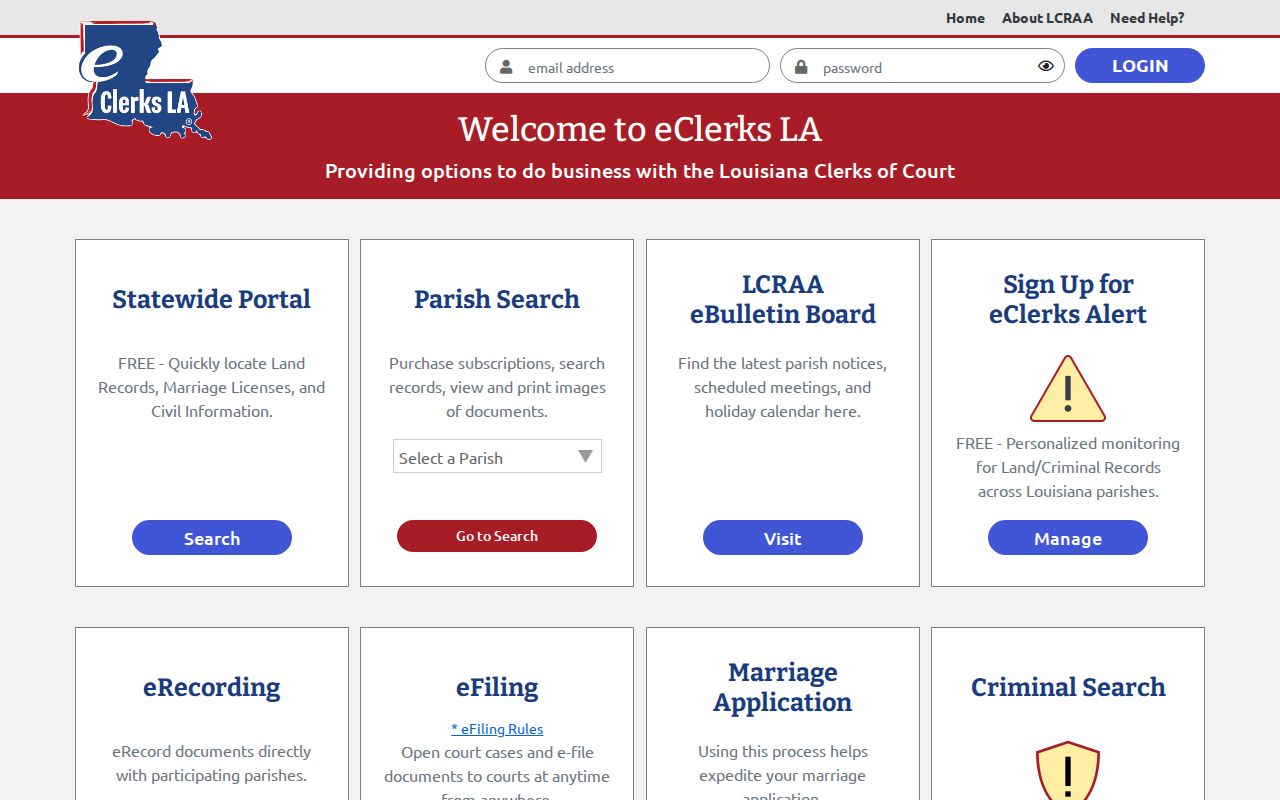
The captured Louisiana screen supports a cautious workflow: sign in first, then verify the Louisiana parish service and its actual record set.
Louisiana Case Minutes vs Full Files
Louisiana R.S. 13:5992 helps explain the statewide index. Its reportable event groups include arrest or summons, custody and bail, charge filing or amendment, motions and settings, trial or adjudication, guilt results, and sentence by count. Those minute entries form a useful timeline. They are not the complaint, bill of information, indictment, motion, transcript, exhibit, judgment image, or certified disposition.
The Louisiana clerk is the legal custodian of the full judicial record under C.C.P. art. 251. Since January 1, 2026, Louisiana criminal pleadings may be filed electronically or in person. Protected identifiers must be left out or redacted from electronic filings. That includes the first five digits of a Social Security number, a complete date of birth, complete account numbers, and other protected identity data.
Clerk Connect is another Louisiana subscription route used by participating Louisiana clerks.
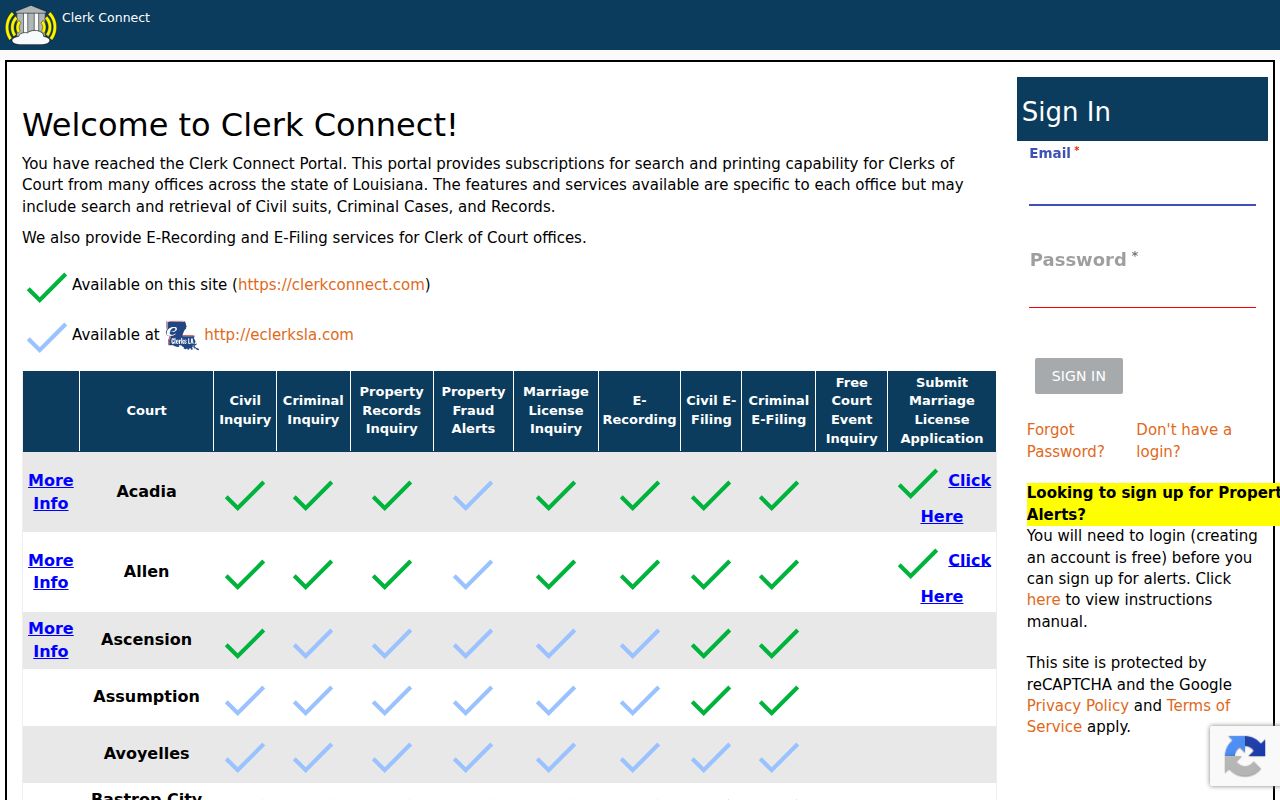
Its presence does not prove that every Louisiana parish, Louisiana case date, criminal image, or certified copy is available through the same account.
What the Case File Shows
A Louisiana criminal case file ties each charge to a sequence of court action. Read by count. One count may be dismissed while another ends in a plea or verdict. The caption, court, division, and docket number establish where the matter was filed. Minute entries show what happened on hearing dates. The judgment and sentence show the final result when one exists.
| Case Number & Court | Local docket identifier, parish, judicial district, division, judge, filing date, type, and status. |
|---|---|
| Charging Documents | Bill of information or indictment, original and amended counts, statute, and offense grade. |
| Docket Entries | Counsel activity, motions, discovery, continuances, bond changes, capias entries, and court minutes. |
| Hearing Dates | Arraignment, motion, pretrial, trial, competency, revocation, and sentencing settings. |
| Disposition | Result for each count, such as dismissal, nolle prosequi, no-bill, acquittal, plea, or verdict. |
| Sentence & Judgment | Confinement, probation, fines, costs, restitution, credit, and concurrent or consecutive terms as ordered. |
Full birth dates, Social Security numbers, protected addresses, victim or minor names, and confidential reports may be redacted from Louisiana files. Louisiana juvenile, sealed, expunged, competency, victim-sensitive, or grand-jury material may not appear at all. An omitted record is not proof that no case exists.
Reading Louisiana Criminal Case Dockets
Louisiana docket terms can change the meaning of a result. “Nolle prosequi” means the prosecutor formally chose not to proceed at that time. A “no-bill” means the grand jury declined an indictment. An acquittal is a not-guilty result after adjudication. A capias is a court order to take a person into custody, often tied to a missed appearance or revocation matter.
- Arraignment
- The formal charge is read or waived and a plea is entered.
- Disposition
- The outcome of each charge, such as conviction, dismissal, acquittal, or no-bill.
- Bill of information
- The district attorney's formal charging instrument in many Louisiana prosecutions.
- True bill
- A grand jury indictment. It is an accusation, not a verdict.
- Capias
- A court order directing that a person be taken into custody.
Do not stop at a Louisiana status label. Check the last Louisiana minute, signed order, and each count's outcome. When LSP BCII lacks a final disposition, it requires an original, unaltered, certified document that accounts for all original and amended charges, outcomes, and the sentence.
Stages of a Louisiana Criminal Case
A Louisiana arrest and booking may lead to a first appearance, bond review, and probable-cause action. Louisiana Code of Criminal Procedure art. 230.1 generally calls for appearance before a judge within 72 hours, subject to its exclusions and remedy. That rule is not a promise that the Louisiana public docket will be searchable in 72 hours.
The Louisiana district attorney may decline, amend, or file charges, or present a felony matter to a grand jury. Louisiana arraignment records the plea. Pretrial entries can track counsel, discovery, motions, continuances, bond, competency, and suppression issues. A case may end through dismissal, no-bill, plea, acquittal, or verdict. Sentencing then records confinement, probation, fines, restitution, and other terms.
Louisiana case flow: Charges Filed › Arraignment › Pretrial › Plea or Trial › Disposition › Sentencing
Note: An appeal creates a separate appellate docket, while the parish clerk keeps the originating Louisiana trial-court file.
When Louisiana Case Records Are Missing
First, confirm the Louisiana court level. A Louisiana traffic, ordinance, misdemeanor, or bench-warrant matter may belong to a city, municipal, or parish court rather than the judicial district index. Next, ask whether the clerk participates in eClerks LA or Clerk Connect for criminal data, what years are indexed, and whether images require a subscription. Louisiana clerks can use different online channels for different record sets.
Older Louisiana files may be paper records that need archive retrieval. Louisiana copies, searches, images, certification, transcripts, and retrieval may carry separate local charges. Louisiana has no universal parish trial-court fee. The Supreme Court's own statutory page and certification rates do not apply to every parish clerk.
The official representative parish clerk gateway demonstrates why the local Louisiana clerk remains essential.
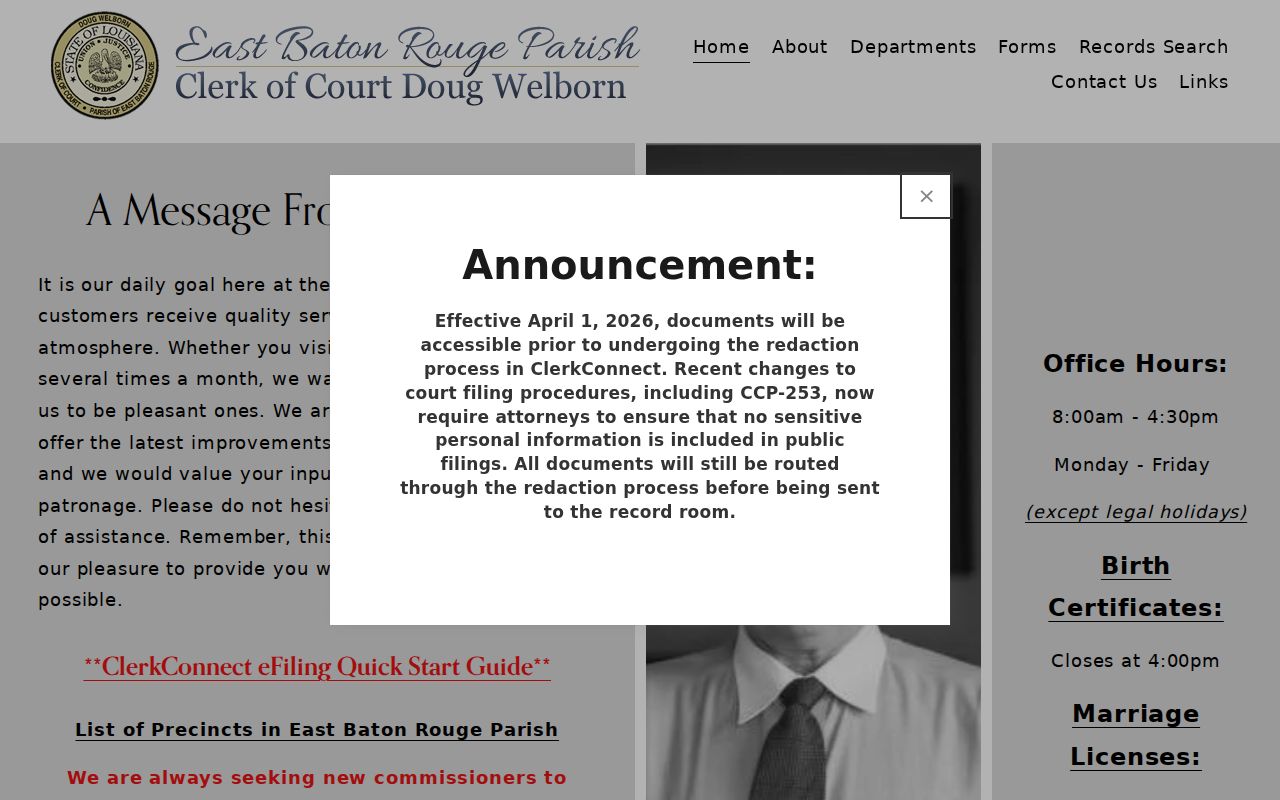
Use a Louisiana clerk's current instructions for access, fees, date coverage, archives, and certified copies rather than projecting one Louisiana parish's process statewide.
Louisiana Appeals and Federal Cases
Louisiana's five appellate circuits publish opinions and orders for cases within their review paths. Use the appellate docket number to cross-reference the trial docket. The opinion may summarize the issues, but the parish file still holds the source pleadings and exhibits. The Louisiana Supreme Court handles review within its constitutional and statutory authority.
Federal criminal cases in Louisiana form a different layer. Louisiana is divided among the Eastern, Middle, and Western federal districts. PACER supplies federal dockets and filed documents after registration. It does not search Louisiana state or parish files. Federal custody also uses the Bureau of Prisons, not a parish jail roster or the state court index.
The official PACER service is the Louisiana federal source for filed federal criminal court records.
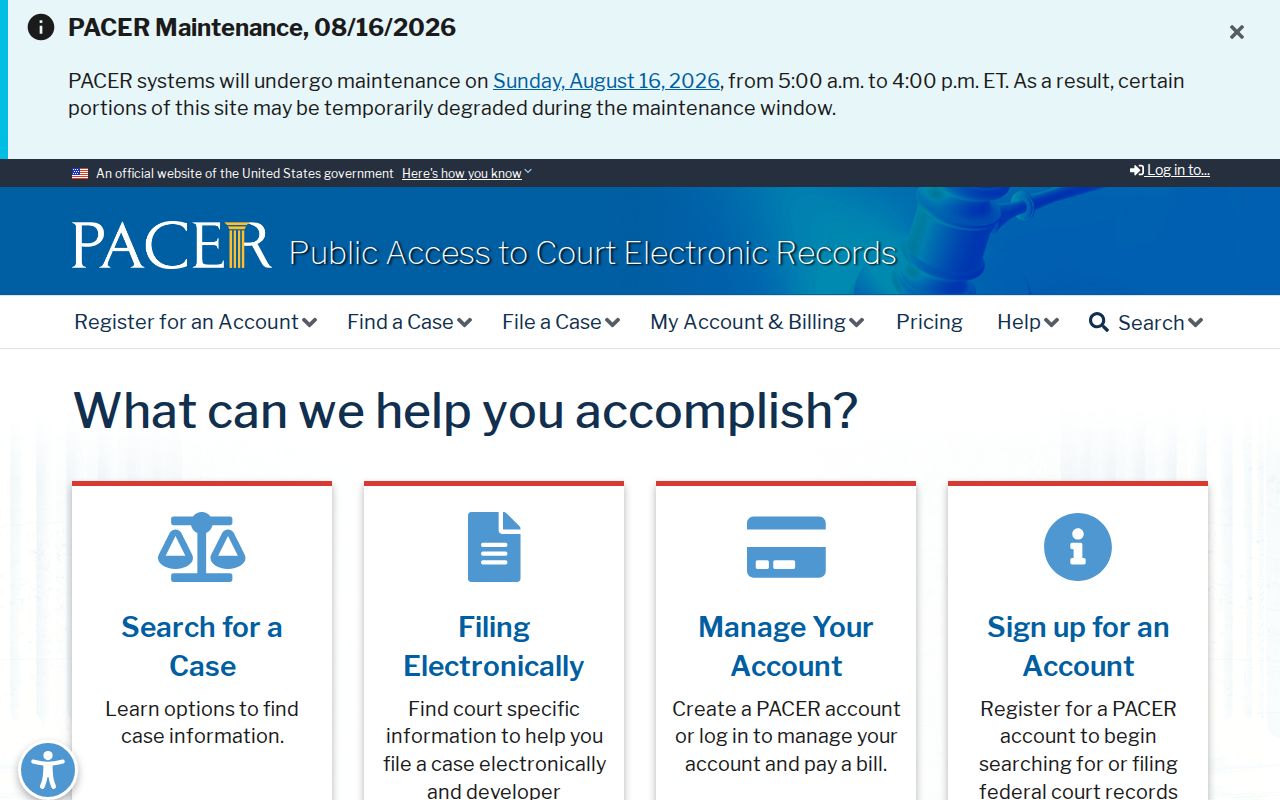
This separate federal system prevents a state-court search from being mistaken for a complete Louisiana litigation check.
Finding Case Records by County
Louisiana uses parishes, even though the retained directory label says “Counties.” The complete Louisiana criminal case file sits with the clerk for the court where the prosecution was filed. Search the Louisiana parish of prosecution, not just a current home address. For Louisiana felony files, that usually means the parish clerk serving the Judicial District Court. Lower-level Louisiana cases may require a separate city, municipal, parish, traffic, or mayor's court clerk.
For a Louisiana record, ask for the exact item needed: an index result, minute entry, bill of information, indictment, judgment, sentence, document image, or certified disposition. A Louisiana State Police BCII rap sheet is not a substitute. It compiles fingerprint-linked arrest cycles and reported outcomes, while the parish case file is the original judicial record. Neither Louisiana source replaces the other.
Browse the full directory of all 64 Louisiana counties to reach the local criminal records site for each parish. Then verify the official Louisiana court, access channel, date range, and copy rules before placing a request.