
About Louisiana State Police BCII
The Bureau of Criminal Identification and Information sits within Louisiana State Police, Public Safety Services, under the Louisiana Department of Public Safety and Corrections. Its repository function is also identified as BCII-LCJIS. Louisiana State Police BCII manages Louisiana Computerized Criminal History, or LACCH, along with fingerprint identification, applicant processing, record review, corrections, and expungement updates.
Louisiana is a closed-record state at the repository level. Louisiana LACCH is not an anonymous public people-search index. Louisiana Revised Statute 15:587 controls dissemination to Louisiana criminal-justice agencies and noncriminal-justice organizations with statutory authority. R.S. 15:588 gives a person the right to inspect and review their own Louisiana record. That split determines which Louisiana BCII service a requester may use.
The official Louisiana agency service overview is shown on the LSP BCII source page.
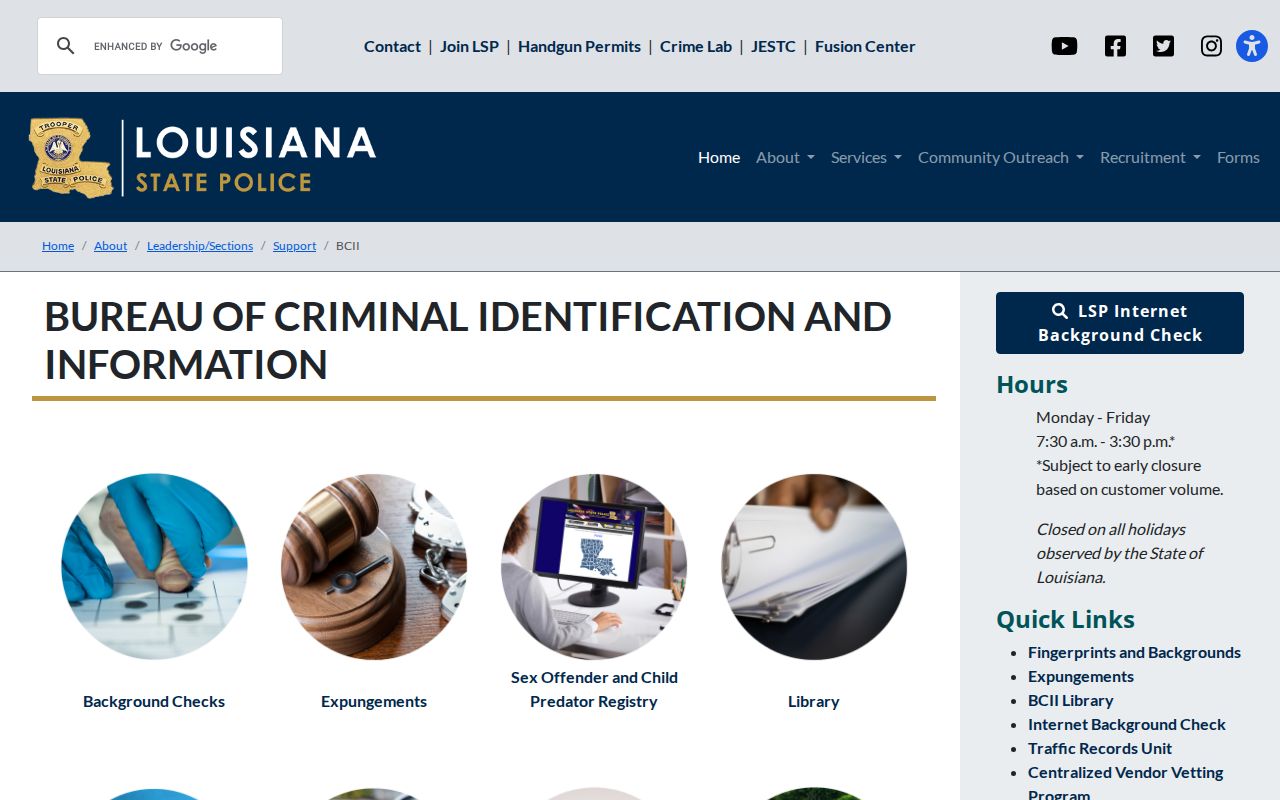
The page brings together LACCH, AFIS, LAPS, Internet Background Check, Right to Review, and the correction route under one statewide bureau.
LSP BCII From Ink to LACCH
Louisiana State Police traces its Louisiana institutional roots to 16 motorcycle officers in the 1922 Highway Commission. Louisiana Act 94 of 1936 combined Highway Patrol and the Bureau of Criminal Investigation into a Department of State Police. The Louisiana identification system later moved from ink fingerprint files to automated fingerprint matching, livescan booking, integrated mugshot and criminal-history processing, and LACCH.
That Louisiana modernization did not create a public conviction-search state. It moved Louisiana identity matching, authorized transactions, and personal record review into faster electronic channels while keeping dissemination closed by law. Modern Louisiana Right to Review uses the Louisiana Applicant Processing System, known as LAPS, and IdentoGO community fingerprint sites. A Louisiana subject may choose a mailed raised-seal true copy or, when available, a secure electronic true copy.
Louisiana history matters because current Louisiana records still mix electronic and older manual material. A recent Louisiana livescan event can match a fingerprint master quickly, while an older ink-card event or late court outcome may need manual work. Louisiana BCII compiles the statewide summary, but it does not replace the Louisiana parish agencies that created each source document.
Note: Louisiana’s move to electronic fingerprints improved identity matching, but older manual records and late dispositions can still require source-file review.
Criminal History Checks Offered by LSP BCII
LSP BCII offers different Louisiana products for different legal routes. Right to Review is the public-facing method for a person to see their own Louisiana repository record. Authorized Louisiana organizations can use the Internet Background Check gateway when a statute permits access. Some authorized Louisiana fingerprint checks add an FBI component. A person who cannot physically appear may use Louisiana BCII’s fingerprint-card mail accommodation.
| Product | Who May Order | What It Returns | Cost |
|---|---|---|---|
| Right to Review, mailed true copy, 27N4RK | The record subject; representative delivery is allowed | Certified, signed, raised-seal Louisiana response | $31 state charge plus the site or capture amount shown during scheduling |
| Right to Review, electronic true copy, 27N3ZZ | The Louisiana record subject | One-time secure computer link available for 30 days | $31 state charge plus site or capture amount; confirm current scheduler availability |
| Right to Review mail-card accommodation | A subject physically unable to appear | Louisiana response based on two FD-258 cards and required forms | $31 plus fingerprint-card and mailing costs |
| Authorized Louisiana IBC check | An approved account under R.S. 15:587 | The LACCH response allowed for that statutory category | $31 basic state request, including the technology fee |
| Authorized state and FBI check | An entity with specific legal authority | Louisiana and FBI responses allowed for the request | $31 state component, $13.25 FBI component, plus capture fee |
None is an unrestricted Louisiana public name search. A Louisiana parish court index, booking record, or public registry search remains a separate product controlled by another Louisiana custodian.
LSP BCII Fee Forms Conflict
An older Louisiana Right to Review authorization PDF still states $26. Current Louisiana materials and the September 24, 2024 form state $31 because a $5 technology fee was added. The Louisiana IdentoGO capture charge appears during scheduling and is separate. Parish fingerprint-card, certified-copy, or mailing costs may also be separate. Use the current Louisiana BCII page and enrollment screen rather than relying on a saved older form.
The Right to Review authorization form is available from the official Louisiana State Police PDF.
The current Louisiana form requests the subject’s identity details, signature, and payment information needed to route a fingerprint-backed Louisiana personal record review.
How Records Flow Into the LSP BCII Repository
A Louisiana arresting or booking agency captures fingerprints and arrest details. Livescan can send them through AFIS, while BCII manually processes ink cards where electronic capture is unavailable. The fingerprint submission matches an existing master identity or creates a new one. The arrest cycle then becomes part of LACCH. A court or prosecutor later sends the disposition that should be linked to that event.
Data flow: Parish Arrest › Fingerprint Submission › Louisiana State Police BCII › Court Disposition Reporting › LACCH Rap Sheet
The Louisiana handoff can fail. A disposition may arrive late, lack a clean match to the Louisiana arrest, or omit a needed charge outcome. Under R.S. 15:597, responsible Louisiana entities generally report final disposition within 30 days, but the local file remains the source proof. Louisiana LACCH also contains probation, parole booking, and incarceration information tied to Louisiana fingerprint-supported entries. It does not claim to contain other states’ arrest and conviction data.
When a Louisiana entry lacks an outcome, Louisiana BCII directs the subject to obtain an original, unaltered, certified disposition from the Louisiana clerk, district attorney, or city prosecutor. The document must cover every original and amended charge, each outcome, and the sentence. A short Louisiana docket printout may not be enough.
LSP BCII Automation Has Gaps
The federally hosted 2022 State Criminal History Records Survey provides a dated snapshot, not a live 2026 total. Louisiana reported about 2,605,600 repository subjects. About 1,999,700 were automated and 605,900 remained manual, for roughly 77 percent automation. Only about 27 percent of arrests had final dispositions, and about 38 percent of felony charges did. Of roughly 148,000 final dispositions received in 2022, about 18 percent could not be linked to a specific arrest.
Those Louisiana figures explain why a rap sheet and parish case file can disagree without either being a fabricated record. The Louisiana summary depends on local fingerprint and disposition reporting. An old Louisiana paper case, name-only event, amended charge, or city-court matter may not align cleanly. The right response is to compare the Louisiana BCII line with the originating source, not to assume the state summary contains every document.
Recent Louisiana grants target court disposition, mental-health, arrest, filing, and adjudication gaps across CMIS, LACCH, NICS, and federal sharing. Louisiana improvements can speed future updates, but they do not cure every historical mismatch at once.
Note: The 2022 repository statistics are an administrative snapshot and should not be presented as live Louisiana totals.
How to Order an LSP BCII Check
Most members of the public should use Right to Review for their own Louisiana criminal history. Start on the BCII page, then enter the appropriate service code in the IdentoGO enrollment gateway. Mailed service code 27N4RK produces the signed and embossed true copy. Electronic code 27N3ZZ should be confirmed in the live scheduler because an older LSP guide called it temporarily disabled while current BCII materials describe electronic delivery.
- Choose the lawful product. Use Right to Review for your own record; an approved organization uses IBC only under its statutory authority.
- Select mailed or currently available electronic delivery, and enter the matching service code.
- Provide the identity and contact details requested by LAPS, choose a site, and schedule fingerprint capture.
- Bring the scheduler’s required identification and payment, then keep the appointment and payment confirmations.
- Read each arrest cycle and obtain the parish court source file for any entry that needs context or correction.
The official Louisiana enrollment interface is shown through the LAPS and IdentoGO source.
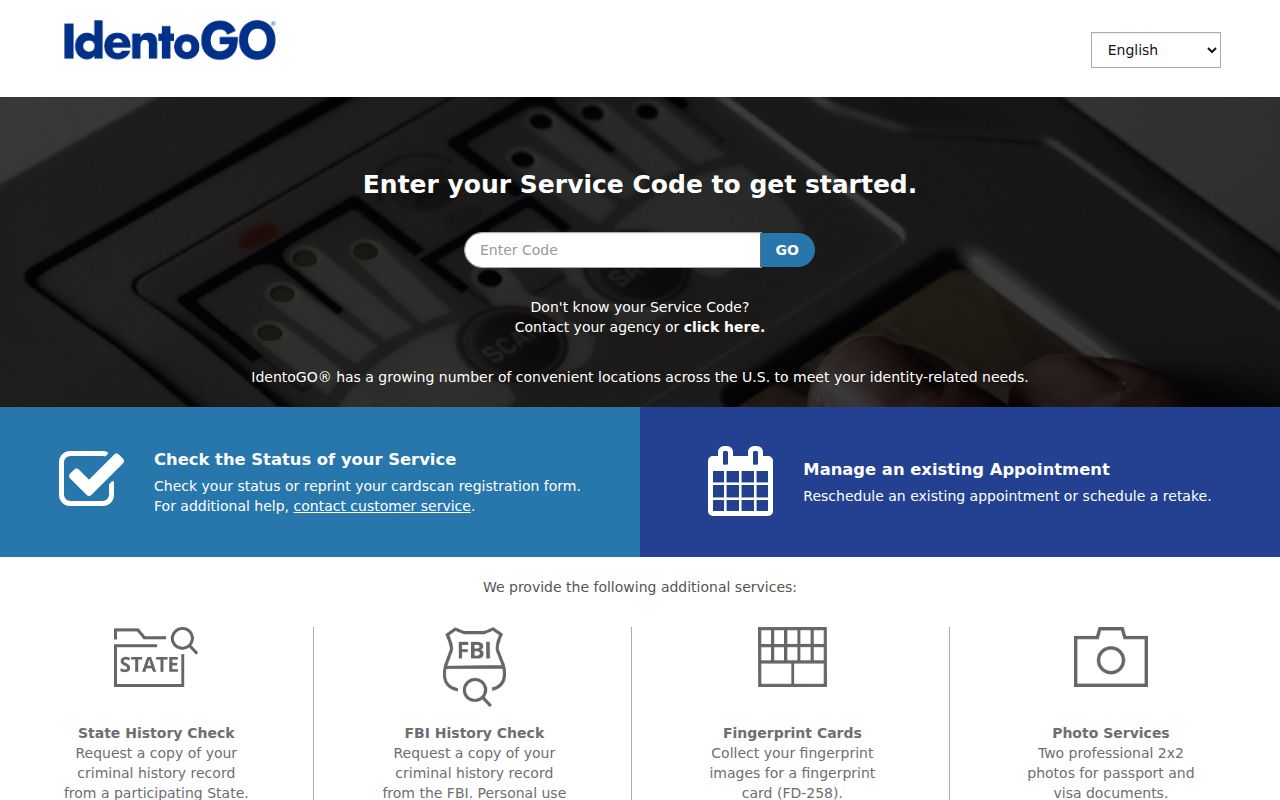
The Louisiana scheduler routes each request by service code, identity details, location, date, and time rather than offering a general Louisiana public person search.
LSP BCII Delivery Needs Care
The mailed Louisiana result is printed, stamped “True Copy,” signed, embossed with a raised Louisiana seal, and sent to the selected address. Some official Louisiana transactions require that physical raised-seal version. A representative can receive it when the requester supplies the authorized recipient’s address during enrollment. People who are physically unable to attend may mail two FD-258 fingerprint cards with the Louisiana authorization, disclosure, payment, and representative form when needed.
Louisiana electronic delivery has stricter handling. Louisiana BCII describes a secure link that remains available for 30 days, works on a computer rather than a mobile device, and permits one retrieval. The recipient must retain the security answer and save or print the Louisiana result during that access. When an attorney or representative receives the link, the Louisiana requester must separately provide the security question and answer. Fingerprint rejection notices go to the supplied email.
These Louisiana details affect product choice. Choose Louisiana mail delivery when a raised seal may be required or when secure-link handling is impractical. Confirm electronic availability in the Louisiana scheduler before relying on it. Losing access details can mean starting a new appointment.
Note: Choose mailed delivery when another agency requires an embossed seal, and verify the electronic service before scheduling.
LSP BCII Checks vs County Records
LSP BCII provides a compiled statewide identity history. A parish custodian keeps the original arrest, booking, prosecution, and court documents. Neither replaces the other. Use the statewide rap sheet to review fingerprint-linked Louisiana arrest cycles and reported results. Use the Louisiana parish directory when the exact complaint, bill of information, minutes, judgment, sentence, booking data, or certified disposition matters.
| Question | LSP BCII Check | Parish Records |
|---|---|---|
| Coverage | Fingerprint-supported entries reported from across Louisiana | One parish or local court and agency system |
| Source | Compiled Louisiana LACCH rap sheet | Original court, prosecution, arrest, jail, or incident file |
| Freshness | Depends on Louisiana local reporting and successful linking | Updated as the local case or custody event changes |
| Detail | Arrest cycles and reported summary outcomes | Pleadings, minutes, orders, narratives, and certified judgments |
| Best use | Reviewing your statewide Louisiana repository identity history | Confirming the full facts and outcome of a particular local event |
Note: A missing LACCH disposition does not erase the parish case, and a parish index does not show every statewide fingerprint-linked event.
LSP BCII Runs Louisiana CJIS
Louisiana State Police is the state’s FBI Criminal Justice Information Services Systems Agency. Through the Louisiana Law Enforcement Telecommunications System, it connects authorized justice users with NCIC, the Interstate Identification Index, and NLETS. BCII describes training, security monitoring, agency audits, and monthly validation of wanted and stolen-property entries. Its public scale statement lists more than 22,225 certified users and more than 22,251 devices.
AFIS provides the identity spine. BCII reports more than 100 livescan booking sites, plus Full Function Remote sites. A new fingerprint set is compared with existing records so a later event can be tied to the correct master identity. Remote functions can also support mugshot work and latent-print searches for authorized agencies. These restricted tools are not public record-search portals.
This broader CJIS role explains why LSP BCII does more than issue personal copies. The bureau manages access, identity matching, validation, quality control, and network rules for systems used across Louisiana. Public access still follows the narrower Right to Review and source-agency routes.
Correcting Errors in Your LSP BCII Record
Begin with a fingerprint-based Right to Review. Identify the exact arrest cycle, identity segment, or outcome that appears wrong. Then compare it with the source held by the parish clerk, prosecutor, jail, or arresting agency. A general public-record request is not a substitute for BCII’s subject review and correction process.
- Order your own LSP BCII Right to Review and mark the disputed entry.
- Obtain an original, unaltered, certified disposition showing your name and date of birth, matching arrest date, every original and amended charge, every outcome, and the sentence.
- Send the certified proof through BCII-LCJIS correction instructions, retaining copies and delivery proof.
- After processing, order a fresh Right to Review and also check the parish docket when a court-ordered expungement is involved.
Identity misassociation may require a fingerprint-supported challenge rather than only a disposition document. Louisiana’s administrative process distinguishes a BCII data correction from a correction to the court’s own public file. The reviewing officer generally has 45 days to audit, with written results due within 15 days after final action. A qualifying adverse decision has a separate appeal route.
LSP BCII Targets Faster Updates
LSP’s fiscal 2026 through 2031 plan targets processing or electronic availability for 90 percent of criminal-history update requests and 75 percent of civil requests within 15 days. The targets measure agency work, not a guarantee for every transaction. BCII still depends on timely and complete source reporting by courts, prosecutors, arrest agencies, and corrections offices.
The 2025 statewide court report illustrates the handoffs. CMIS received 373,687 criminal records, forwarded 46,468 qualifying records to DPS criminal history, and sent 38,188 to FBI NICS. Those counts describe different transfers, not one total population. They show why court modernization and repository quality are linked but remain separate functions.
For a current record review, keep both levels in view. LSP BCII controls the statewide compiled entry and its correction. The parish custodian controls the original case or arrest file. Faster electronic reporting narrows lag, but certified local proof remains central when an older or incomplete record must be fixed.
Note: Faster statewide reporting does not remove the need for a certified Louisiana parish disposition when a repository entry is incomplete.